How to Build a Complete Tea Set: Cups, Saucers, Strainer, and Tray
A tea set is not a matching box you buy once. It is a small working collection you build around the way you actually brew. Someone who drinks one large mug of Assam every morning needs different pieces than someone pouring five small cups of oolong for friends on a Sunday afternoon. The encouraging part: cups, saucers, strainer, and tray can be chosen one at a time, and a set assembled with a little thought usually looks better than a boxed one, because every piece has a job.
Start With the Brew, Not the Box
Before you look at a single cup, answer three questions on paper. How many people drink at once, on a normal day and on a hosting day? Do you brew in a pot and pour, or brew in the cup with a basket? And what kind of leaf do you drink most — large whole leaves, broken leaves, or fine pieces and herbal blends?
Those answers set your sizes. A solo drinker pouring Western-style usually wants a pot around 400–600 ml and cups that hold 200–250 ml. For small-cup brewing, a 150–200 ml pot with 60–100 ml cups is a comfortable starting point. Hosting four people for a long afternoon? Either a larger pot or a small pot refilled several times, plus one more cup than you think you need.
Leaf size matters just as much. Whole, twisted leaves need room to open, so a cramped basket will leave you with a thin, uneven cup. Fine pieces and herbal blends need a tighter mesh or you will be picking bits out of your teeth.
Cups and Saucers: Size, Shape, and Feel
Cup volume is the first decision, but shape decides how the tea tastes in your mouth and how long it stays hot. Flared rims cool tea quickly and are pleasant for delicate greens and light oolongs. Straight-sided cups hold heat longer, which suits black tea and roasted oolong. Thin porcelain feels refined on the lip but loses heat fast; thicker stoneware keeps temperature and feels sturdy in the hand.
Saucers are often dismissed as decoration. They are not. A saucer catches the drip when you pour, gives a resting place to a small strainer or spoon, and lets a guest set a hot cup down without hunting for a coaster. If you mostly drink alone at a desk, you can skip them and add them later. For gatherings, they quietly prevent a lot of table rings.
What to check in your hand
- Balance: an empty cup should not tip forward when set down.
- Handle: two fingers should fit without touching the hot body.
- Rim: a slightly thin lip feels better than a thick, blunt one.
- Nesting: if you stack cups, check that they do not jam together.
- Replacements: buy one extra cup of the size you use daily. Breakage happens.
The Strainer Does More Work Than You Think
There are three common types, and each suits a different habit. A basket infuser sits inside the cup or mug and lets you brew without a pot. A pot-mounted strainer rests on the rim of the teapot or pitcher and catches leaves as you pour. A handheld mesh strainer is used over a cup, either alone or after pouring from a pot that has no filter built in.
Mesh fineness is the detail people overlook. Very fine mesh stops dust and small particles but can slow the pour and clog quickly. Medium mesh lets whole leaves move and drains fast. If you drink both whole-leaf teas and finely cut blends, own two strainers rather than forcing one to do everything.
Fit matters as much as mesh. A basket that fills the entire cup leaves no room for leaves to expand, and the tea will taste flat and bitter. Look for a basket that leaves a finger's width of space around it. Rinse the strainer the moment you finish brewing; dried leaves set like cement in fine mesh. A small soft brush kept near the sink solves most of it.
The Tray Ties Everything Together
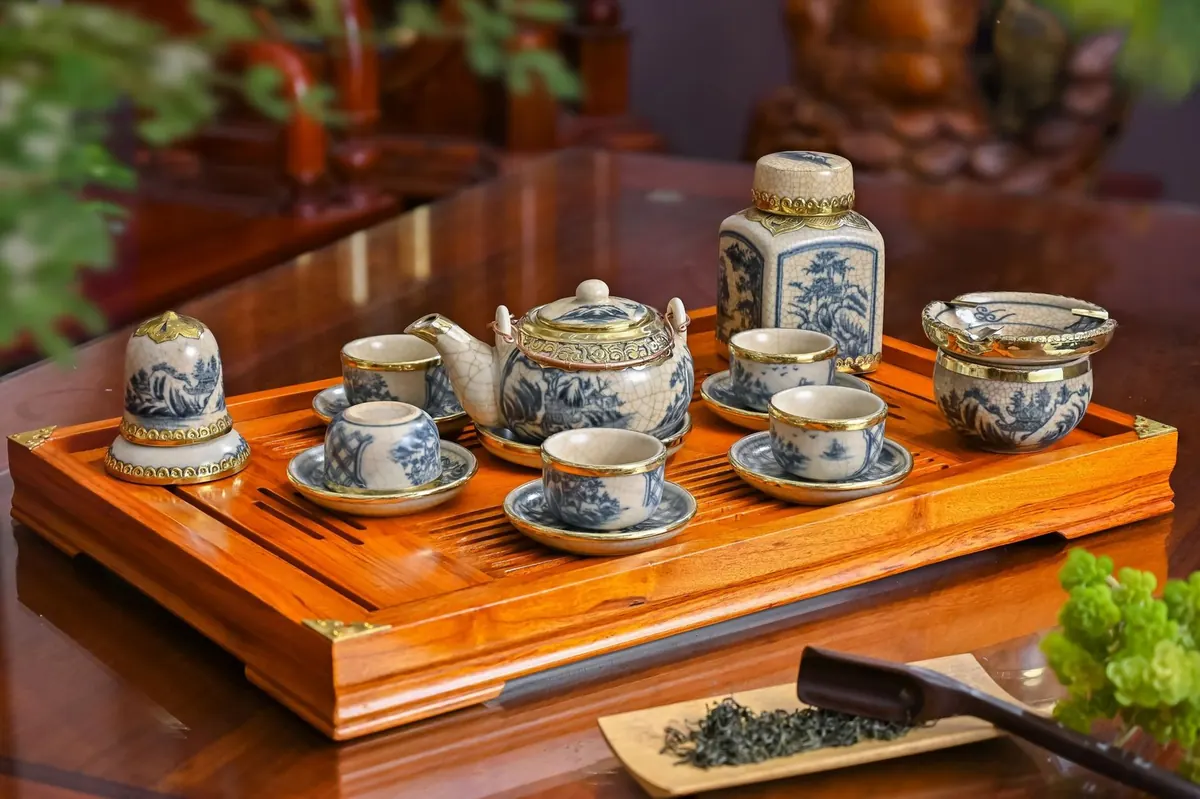
A tray is the piece that turns separate objects into a set. It catches drips, lets you carry a full pot and two cups in one trip, and gives the whole ritual a defined edge on the table.
Measure before you buy. Lay out your pot, two cups, and whatever else you use — a small pitcher, a waste bowl, a strainer rest — and note the footprint. Add a couple of centimetres of margin. A tray that fits everything is useful; a tray that is slightly too small is a permanent annoyance.
Material changes the experience. Wood feels warm and quiet, but it needs drying after use and dislikes standing water. Glazed ceramic and stoneware wipe clean and hold heat, though they are heavy to carry. Metal is light and thin, and can feel cold against a warm pot. Slatted bamboo with a raised lip drains well and handles splashes gracefully. If you plan to carry the tray, choose one with a rim; a flat board with a full pot on it is a gamble.
Making Mismatched Pieces Look Intentional
Coordinated does not mean identical. Pick one anchor piece — often the pot or the tray — and let it set the rules. Then choose two or three constraints and keep them consistent across everything else. You might decide on a warm neutral palette, matte surfaces, and rounded silhouettes. Within those limits, vary size and shape freely.
A reliable formula is two neutrals plus one accent: off-white cups, a sand-coloured tray, and a deep green or iron-black pot. Another is same glaze, different forms — cups, pitcher, and waste bowl in one glaze family, each a different shape. Consistency of scale matters more than matching pattern. Cups that are wildly different in height next to each other read as accidental, even when the colours agree.
A Starter Order That Works
- Count your usual servings and your hosting maximum.
- Choose the brewing vessel: pot, gaiwan, or a cup with a basket.
- Pick cups whose volume matches one serving from that vessel.
- Add saucers if guests are part of the plan.
- Choose a strainer that fits your vessel and your most common leaf.
- Size the tray to the full layout, with margin.
- Add extras last: pitcher, waste bowl, spoon, tea towel.
Living With the Set
Build slowly and buy the pieces you reach for. A set assembled over a year or two tends to age better than one bought in an afternoon, because each addition answers a real problem you ran into — a cup too small, a strainer too coarse, a tray that dripped on the tablecloth.
Keep a simple routine. Rinse everything with hot water after use, dry the tray and any metal, and let cups air upside down on a clean cloth. Rotate your pieces so nothing sits unused for months. If you buy vintage or unmarked ceramics and are unsure about the glaze, ask the seller about food safety or keep that piece for dry storage; a local potter or ceramic supplier can advise. Then pour yourself something, use the good cups, and let the set earn its wear.
Photo: Sứ Bát Tràng / Pexels
You Might Also Like
Rotate teapots, trays, linens, and flowers four times a year to keep a small home tea corner fresh, usable, and quietly seasonal.
Match a teapot to a tea lover's habits, space and taste with this practical guide to sizes, materials, styles and the small details that make a gift usable.